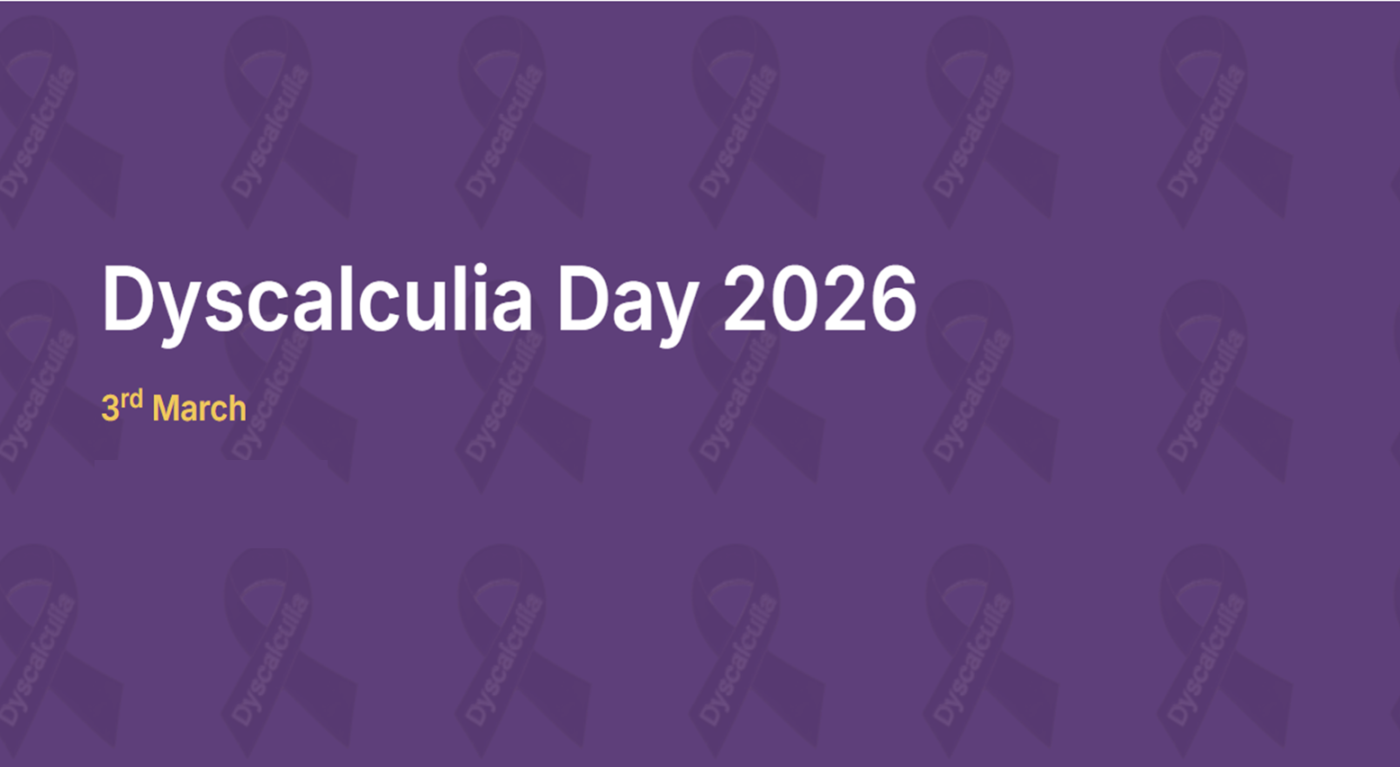
On 3rd March 2026, educators, parents, learners and researchers around the world will come together to mark Dyscalculia Day — a day dedicated to raising awareness, improving understanding, and challenging long-held assumptions about mathematical difficulty.
This day matters deeply to us. Too many children and adults grow up believing they are “bad at maths”, when in reality they are navigating a learning difference that has gone unseen, misunderstood, or unsupported.
What is dyscalculia?
Dyscalculia is a specific learning difficulty that affects the way people understand and work with numbers. It can impact:
-
Number sense and quantity
-
Recall of basic number facts
-
Understanding place value
-
Working with time, money, and measurement
-
Following multi-step mathematical processes
Importantly, dyscalculia is not a reflection of intelligence. Many people with dyscalculia have strong verbal reasoning, creativity, or problem-solving skills but maths can feel disorientating, overwhelming, or inaccessible without the right support.
It is estimated that ~6% of the population experience dyscalculia, yet it remains far less recognised than other learning differences. As a result, many learners are labelled as inattentive, careless, or lacking effort, rather than being given the understanding and adjustments they need.
Why dyscalculia day matters
Dyscalculia Day exists to shift the narrative.
It reminds us that:
-
Maths difficulty is not a personal failing
-
Early experiences of confusion can shape lifelong confidence
-
Teaching approaches matter enormously
-
Awareness is the first step towards inclusion
For educators, it’s an opportunity to reflect on how maths is taught and how flexible our approaches truly are.
For parents, it offers reassurance and language to better understand their child’s experience.
For adults, it provides validation, often for the first time, that their struggles have a name and a reason.
Rethinking maths for all learners
We believe that clarity, structure and careful sequencing are essential, particularly for learners who find maths difficult. When concepts are broken down, language is precise, and representations are consistent, maths becomes easier to navigate and less intimidating.
Supporting learners with dyscalculia requires:
-
Explicit teaching
-
Thoughtful use of representations
-
Time to build secure foundations
-
An understanding that confidence and competence grow together
Dyscalculia Day aligns closely with our missions: to rethink inclusion and to rethink confidence.
Join the Dyscalculia Day 2026 Conference
To mark Dyscalculia Day 2026, the Dyscalculia Network is hosting a dedicated online conference bringing together researchers, educators, parents and individuals with lived experience.
The conference offers:
-
Practical insights into recognising and supporting dyscalculia
-
Research-informed approaches to inclusive maths teaching
-
Perspectives from adults and young people with lived experience
-
Guidance for schools, families and workplaces
If you care about inclusive maths education this is a valuable opportunity to deepen your understanding and be part of a growing conversation.
👉 Find out more and join the Dyscalculia Day 2026 Conference here:
https://dyscalculianetwork.com/dyscalculia-day-2026/