Fairy tales have been told for generations. They are familiar, comforting, a little bit magical, and they are also a brilliant vehicle for early mathematics.
On Tell a Fairy Tale Day, it is the perfect moment to pause and reflect on how stories can help children build strong mathematical foundations in ways that feel playful, meaningful and deeply engaging.
In the early years, mathematics is about making sense of the world. It is about noticing patterns, comparing quantities, exploring space, talking about what we see and using language to describe relationships. Fairy tales offer a rich shared context where all of this can happen naturally.
Strong foundations start with meaning
Young children learn best when ideas are rooted in experiences they understand. Fairy tales give us ready made contexts that children can step into through role play, small world, construction and storytelling.
When mathematics is woven into these narratives, it stops being abstract. It becomes purposeful.
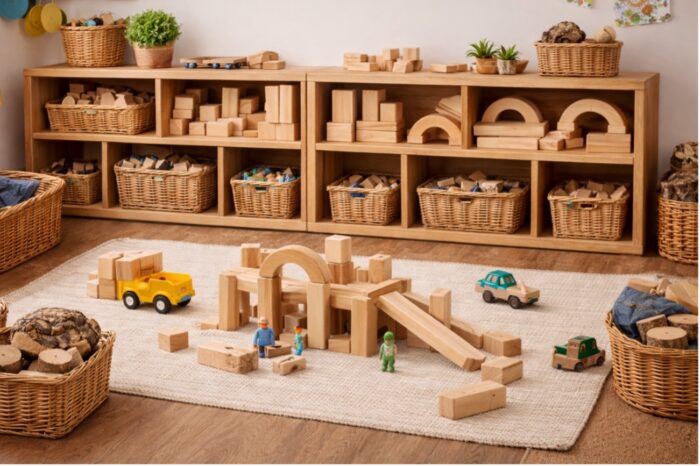
For example, we might build the houses from The Three Little Pigs, choosing blocks we can stack, rotating them to make enclosures and positioning them carefully to create a roof.
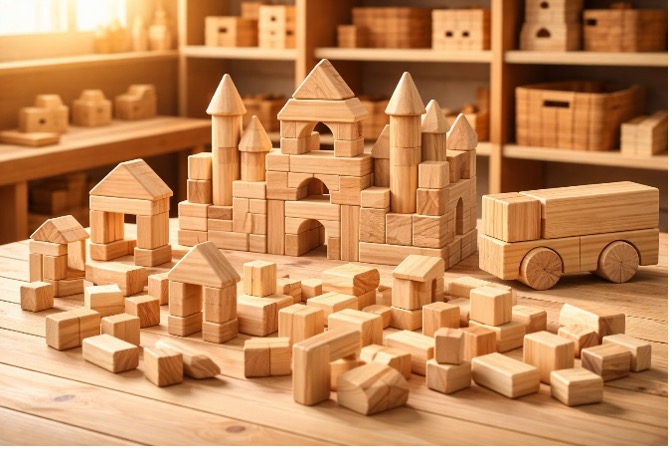
This is how foundations are built, through repeated, meaningful encounters with number, measure, shape and spatial thinking, all grounded in play.
Let us look at some of the mathematics that fairy tales make possible.
Counting, comparing and subitising through familiar stories
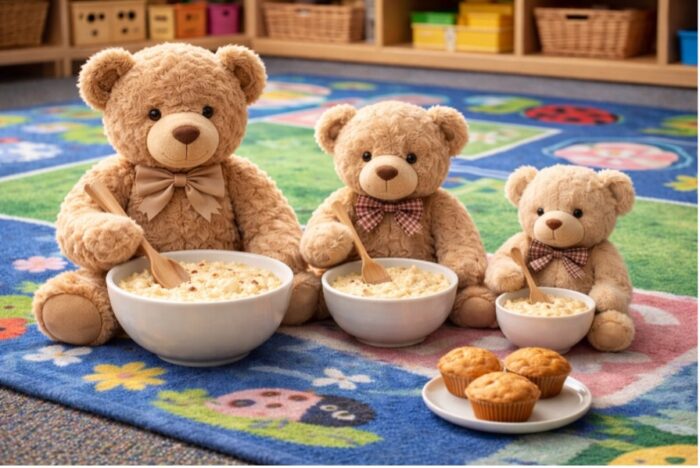
Recreating the Three Bears’ house and their breakfast from Goldilocks and the Three Bears opens up rich mathematical thinking. Children might give each bear a bowl, a spoon and a cup, developing their one-to-one correspondence and together we can notice:
- Do we have enough?
- Do we have more bowls or more bears?
- Are there fewer cups than bears?
- What do we need to add so everyone gets one?
Stories like The Three Billy Goats Gruff or The Three Little Pigs are perfect for developing early subitising. As you read, pause and ask:
- How many goats can you see?
- How many pigs are there?
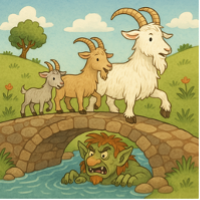
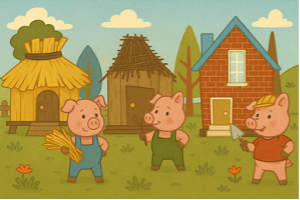
Children begin to recognise quantities of 1, 2 and 3 without counting each time. Over repeated readings, this builds confidence and fluency with small numbers.
Exploring measure, size and comparison
Fairy tales are full of contrast, which makes them ideal for exploring measure.
In Goldilocks and the Three Bears, we naturally talk about big and small, full and empty. Children can pour, compare, fill and empty bowls or containers, linking language directly to experience.
Jack and the Beanstalk brings height and length to life. Children might grow their own beanstalks and notice how they become taller and taller. This is not just about measuring. It is about noticing change over time.
We can explore height, build a beanstalk using cardboard boxes, tubes, or blocks. Create a vertical height track that children can climb with a character, counting steps or noticing how the structure grows.
You could even explore this outdoors by placing a character inside a clear tube and filling it with water so Jack rises higher and higher. Children see that the more water we pour, the higher the level rises. They experience comparison, volume and cause and effect in a tangible way.
Similarly, recreating The Magic Porridge Pot invites exploration of capacity.
- Which bowl shall we choose?
- How much porridge should we pour?
- Do we need more milk?
- How do we know when it is full?
One more
The Gingerbread Man is a wonderful story for exploring one more. As each character joins the chase, children can build towers of cubes or place counters to represent who is running after him.
Placing these on a five frame or ten frame helps children see both the total number and the pattern of one more. They begin to notice that each time the group grows by one and the next number is said.
Positional language such as first, next and last also comes alive here, as it does in The Enormous Turnip, where characters join one by one. Children can physically line up figures, add one more each time and describe what changes.
Shape, space and construction through story worlds
Construction play inspired by fairy tales opens up rich spatial thinking.
Recreating the houses from The Three Little Pigs invites children to think about:
- How blocks stack
- Which shapes they want to use
- How to make walls and enclosures
- How to create a roof
- Why some structures are stronger than others
- How many blocks they need
Children also need to plan. How many pigs do we need? Do we have enough? This blends number, shape and problem solving seamlessly.
These constructions might move outdoors too.
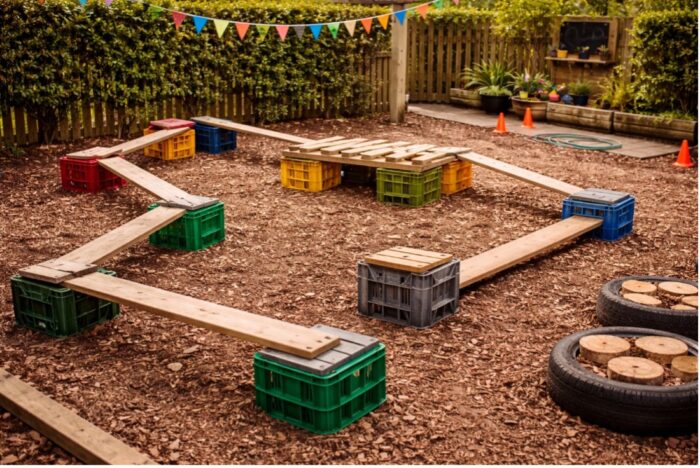
Building the bridge in The Three Billy Goats Gruff encourages children to experiment with rotating bricks, creating stable arches and thinking about how the goats can go over while the troll stays under. Here, positional language such as under, over, on top, next to and between becomes purposeful.
Stories like The Princess and the Pea can spark exploration of the properties of shape.
- Can long blocks balance on curved shapes?
- Why do some shapes roll while others stack?
Maps, movement and positional language
Fairy tales are full of journeys.
In Little Red Riding Hood, children can make maps of the forest using blocks, small world or drawings. They might give directions to reach Grandma’s house while avoiding the woods. Language such as next to, behind, through, around and between becomes meaningful when tied to a goal.
An obstacle course inspired by Hansel and Gretel turns spatial language into full body learning. Children are not just hearing the words. They are living them.
Following children’s lead
These examples are just starting points. The real power of fairy tales in early mathematics lies in what happens next.
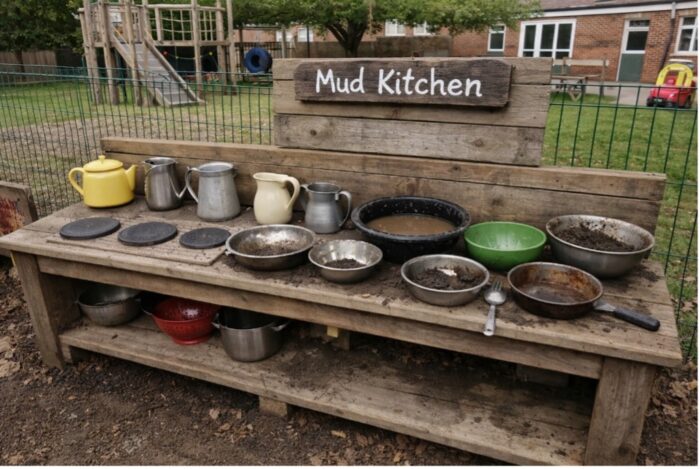
Children may be inspired to reenact parts of the story, setting up the Three Bears’ kitchen in the home corner, rebuilding the Little Pigs’ houses in the construction area, mixing potions in the mud kitchen to wake Sleeping Beauty or extending the beanstalk higher than ever imagined.
This is where we can maximise mathematical opportunities.
When children step into the story world themselves, mathematics becomes embedded in their decisions:
- How many bowls do we need?
- Is this tower tall enough?
- Do we have more wolves or more pigs?
- How can we make it stronger?
- What happens if we add one more?
We can notice the mathematics already happening in play, and where appropriate introduce precise language and gently extend thinking through thoughtful questions.
Fairy tales nurture creativity, language and emotional development. They also offer endless opportunities to explore mathematics in ways that are joyful, meaningful and memorable.
Once upon a time might just be where strong mathematical foundations are inspired, strengthened and brought to life through stories.