Rethink Maths launches Groundwork Maths and welcomes Sophie Lord as Impact Lead

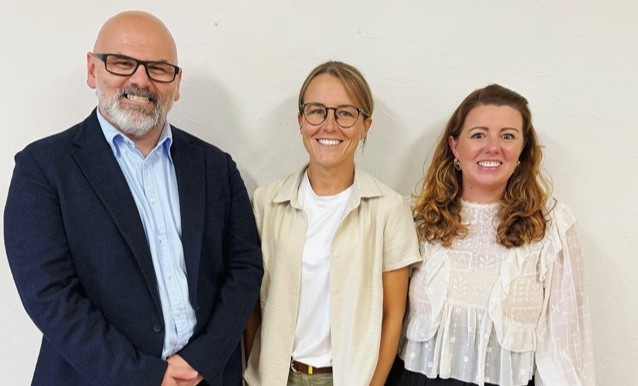
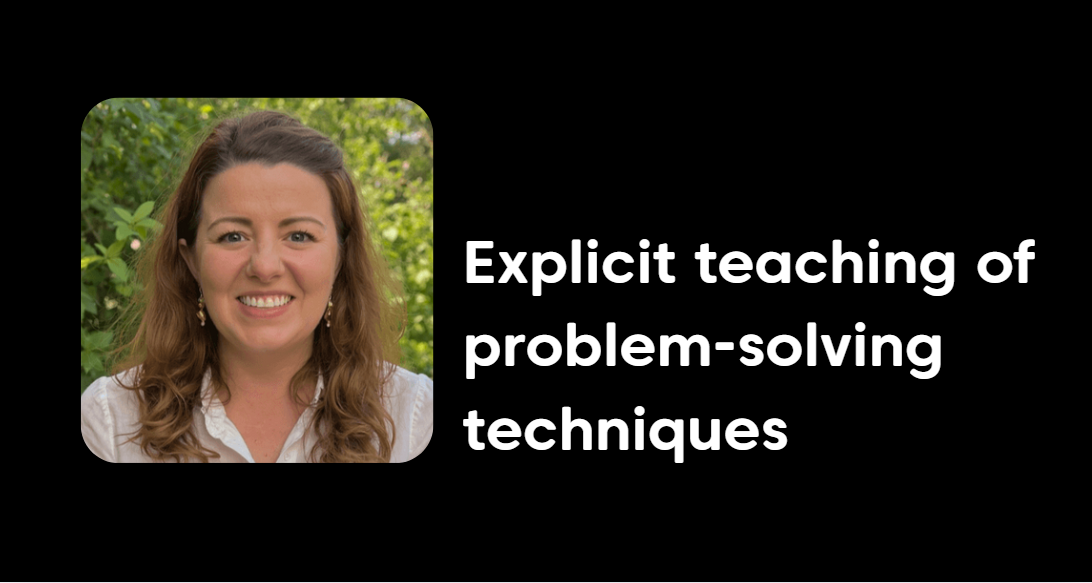
As Rethink Maths officially launches Groundwork Maths, we are delighted to announce the appointment of Sophie Lord as our new Impact Lead.

Groundwork Maths is a new intervention programme designed to help pupils who have fallen behind in mathematics rebuild the essential foundations they need for long-term success. Combining carefully sequenced teaching, high-quality resources and practical classroom support, the programme aims to give schools an effective, evidence-informed approach to intervention that develops both understanding and confidence.

Recognising that even the best programmes rely on excellent implementation, Sophie will play a central role in ensuring that schools are fully supported throughout their Groundwork Maths journey.

In her role as Impact Lead, Sophie will work closely with partner schools from initial onboarding through to successful implementation. She will provide training and support, model effective practice and help schools embed the programme with confidence. Alongside this, she will gather feedback, monitor impact and work with the Rethink Maths team to ensure Groundwork Maths continues to evolve in response to the needs of schools.

Sophie joins Rethink Maths with extensive experience supporting schools and building long-term educational partnerships. A trained teacher, she has taught in schools in both the UK and Spain. Most recently, she was School Relationship Lead at Axiom Maths, where she worked closely with schools to build strong relationships, support programme implementation and help ensure they achieved the greatest possible impact for their pupils. Her classroom experience, combined with her expertise in working alongside school leaders and teachers, makes her ideally placed to support the successful implementation of Groundwork Maths across our partner schools.

Speaking about her appointment, Sophie said:

“I’m incredibly excited to be joining Rethink Maths at such an important stage in the organisation’s journey. Groundwork Maths has the potential to make a genuine difference for pupils who need additional support, and I’m passionate about working alongside schools to help ensure every child has the opportunity to succeed in mathematics. I can’t wait to start working with teachers and leaders across the country.”

Tony Staneff, Co-founder and Director of Impact and Innovation at Rethink Maths, said:

“Groundwork Maths has been developed with one clear ambition: to transform outcomes for pupils who need the greatest support in mathematics. We know that outstanding implementation is just as important as outstanding resources, which is why appointing an Impact Lead was such a significant step for us.

Sophie’s experience, warmth and ability to build trusted relationships with schools make her the ideal person to lead this work. Having worked alongside Sophie previously, I’ve seen first-hand the difference she makes to schools, and I’m absolutely delighted that she has joined the Rethink Maths team.”

The launch of Groundwork Maths marks another exciting milestone for Rethink Maths as the organisation continues its mission of changing the way the world sees and learns maths.

Schools interested in learning more about Groundwork Maths, or finding out how the programme could support their pupils, are invited to register for one of our upcoming launch webinars or get in touch with the team.
Groundwork Maths Launch Event – 7th July 3:45pm

Groundwork Maths Launch Event – 8th July 3:45pm

Shining a light on dyscalculia

On 3rd March 2026, educators, parents, learners and researchers around the world will come together to mark Dyscalculia Day — a day dedicated to raising awareness, improving understanding, and challenging long-held assumptions about mathematical difficulty.

This day matters deeply to us. Too many children and adults grow up believing they are “bad at maths”, when in reality they are navigating a learning difference that has gone unseen, misunderstood, or unsupported.

What is dyscalculia?

Dyscalculia is a specific learning difficulty that affects the way people understand and work with numbers. It can impact:

  • Number sense and quantity

  • Recall of basic number facts

  • Understanding place value

  • Working with time, money, and measurement

  • Following multi-step mathematical processes

Importantly, dyscalculia is not a reflection of intelligence. Many people with dyscalculia have strong verbal reasoning, creativity, or problem-solving skills but maths can feel disorientating, overwhelming, or inaccessible without the right support.

It is estimated that ~6% of the population experience dyscalculia, yet it remains far less recognised than other learning differences. As a result, many learners are labelled as inattentive, careless, or lacking effort, rather than being given the understanding and adjustments they need.

Why dyscalculia day matters

Dyscalculia Day exists to shift the narrative.

It reminds us that:

  • Maths difficulty is not a personal failing

  • Early experiences of confusion can shape lifelong confidence

  • Teaching approaches matter enormously

  • Awareness is the first step towards inclusion

For educators, it’s an opportunity to reflect on how maths is taught and how flexible our approaches truly are.
For parents, it offers reassurance and language to better understand their child’s experience.
For adults, it provides validation, often for the first time, that their struggles have a name and a reason.

Rethinking maths for all learners

We believe that clarity, structure and careful sequencing are essential, particularly for learners who find maths difficult. When concepts are broken down, language is precise, and representations are consistent, maths becomes easier to navigate and less intimidating.

Supporting learners with dyscalculia requires:

  • Explicit teaching

  • Thoughtful use of representations

  • Time to build secure foundations

  • An understanding that confidence and competence grow together

Dyscalculia Day aligns closely with our missions: to rethink inclusion and to rethink confidence.

Join the Dyscalculia Day 2026 Conference

To mark Dyscalculia Day 2026, the Dyscalculia Network is hosting a dedicated online conference bringing together researchers, educators, parents and individuals with lived experience.

The conference offers:

  • Practical insights into recognising and supporting dyscalculia

  • Research-informed approaches to inclusive maths teaching

  • Perspectives from adults and young people with lived experience

  • Guidance for schools, families and workplaces

If you care about inclusive maths education this is a valuable opportunity to deepen your understanding and be part of a growing conversation.

👉 Find out more and join the Dyscalculia Day 2026 Conference here:
https://dyscalculianetwork.com/dyscalculia-day-2026/

James Lansdale-Clegg joins Rethink Maths as Director of Educational Projects

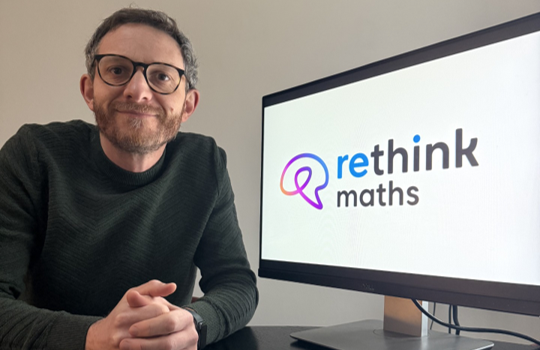
We’re delighted to share that James Lansdale-Clegg will be joining us from the start of January as our Director of Educational Projects.

James joins the leadership team to drive the delivery of our expanding portfolio of projects. He will play a key role in turning ideas into reality and ensure we keep momentum across a suite of projects.

Alongside working with schools, James will collaborate with education suppliers, publishers, government organisations and partners to develop high-quality advice, content and services. He’ll work closely with the Managing Director and leadership team to make sure our work is focused, expertly crafted and genuinely useful for teachers in the classroom.

James brings a deep understanding of the education landscape, alongside a practical and thoughtful approach to delivery. His role will add an extra layer of assurance across our work, with a clear focus on quality and coherence that strengthens and supports the excellent work already happening across the team.

Caroline Hamilton, CEO, said:

“We’re proud of the work we do and proud of the standards we set ourselves. James is someone who consistently delivers high-quality work, even under pressure. He brings focus, expertise, and care – and I’m really excited to have him on board.”

Mary-Kate Connolly, Managing Director, added:

“I’m genuinely excited to be working with James again. He’s someone who gets things done, on time and to a high standard. It’s great to have him joining the team.”

James joins at a time of real momentum for Rethink Maths. Following several appointments made before Christmas, we’re preparing for a busy and exciting 2026. There’s plenty happening behind the scenes and we’re looking forward to sharing more about what we’re building in the near future.

If you’re working on a maths project (UK or international) and would like our support – whether that’s shaping ideas, developing exceptional maths content or delivering at scale – James would love to hear from you.

Big news from Rethink Maths – two brilliant leaders are joining our team

We’re absolutely delighted to share that two incredible educators are joining Rethink Maths as we continue shaping what comes next for maths education.

We’re thrilled to welcome Kate Henshall as our Education Director. Kate will lead our education strategy and our work with schools and teachers. She brings a huge amount of experience across maths education and curriculum development, and anyone who has worked with her knows she’s an absolute superstar. Kate will help ensure everything we create genuinely supports teachers and makes a real difference in classrooms.

We’re equally excited to welcome Kat Martin as our Director of Foundations. Kat will lead our core Foundations mission – our commitment to giving every child, wherever they are in the world, the strongest possible start in maths. She brings deep expertise in early maths, school leadership, and system improvement in an international development setting. Kat is another A-player who shares our belief that strong foundations change everything.

These appointments come at the perfect moment for us. We’re busy building, exploring, prototyping, and shaping what Rethink Maths will become. Having Kate and Kat on board, together with the brilliant Mary-Kate, will elevate everything we’re doing to the next level.

As part of this next stage, we’re also confirming our co-founder roles as the company grows.

Caroline Hamilton will step into the role of CEO, shaping our strategic priorities, building trusted partnerships across the education sector, and empowering our team to deliver excellence at scale. Her leadership will help us stay true to our mission while positioning the company for sustainable growth and continued innovation.

Tony Staneff will become Impact and Innovation Director, focusing on research-informed curriculum design, product innovation, and leading the creative development of new ideas and resources.

We’re incredibly excited about what’s ahead, especially as we begin working with like-minded schools and teachers who want to rethink what maths education could look like.

Caroline said:
“We feel really fortunate to have Kate and Kat joining us. They’re maths experts and brilliant teachers at heart. We’re building something special and bringing in leaders who share our values and vision makes all the difference.”

We’ll be sharing more over the coming months as our programmes, partnerships, and wider vision continue to take shape.

Why Rhyme Matters in Early Maths

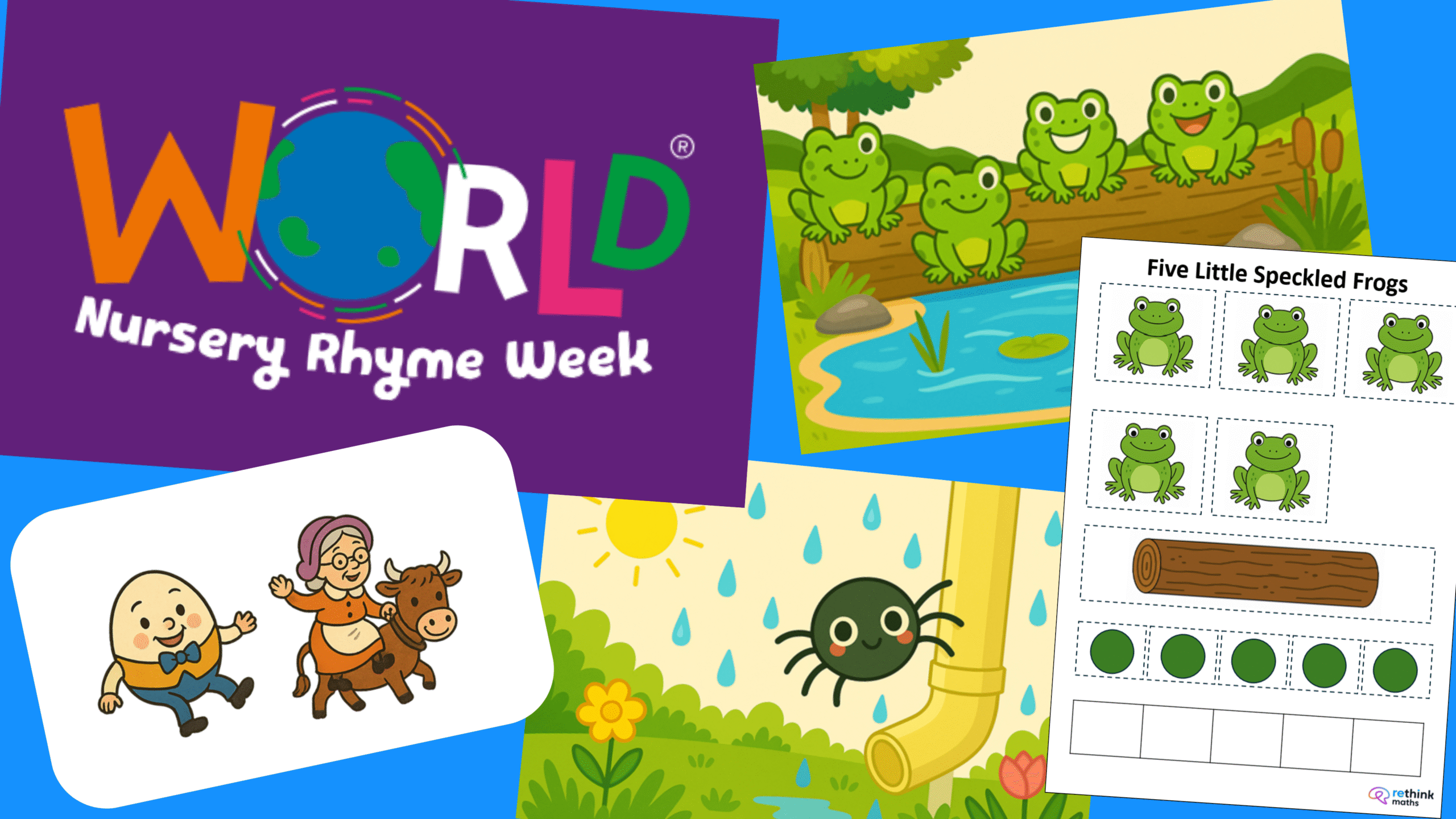
At Rethink Maths we can’t wait to celebrate World Nursery Rhyme Week (WNRW) taking place on 10th to 14th November 2025. WNRW is a wonderful celebration of the songs and rhymes that so many of us grew up with.

But nursery rhymes aren’t just fun little tunes, they’re powerful early learning tools.

One of our missions is ‘Rethink Foundations’, we believe in building deep understanding, lasting confidence and joyful learning through interaction, shared experiences, and play. And nursery rhymes are one way this can be done.

Why nursery rhymes matter

Nursery rhymes:

✅ help children hear patterns in language

✅ support memory and sequencing

✅ encourage early speaking and confidence

✅ offer rhythm and repetition – great for emerging number sense

When a child chants, “One, two, buckle my shoe” or joins in with the actions to, “Round and round the garden,” they’re not just enjoying a moment with you, they’re starting to embed core mathematical ideas:

  • Order and sequence
  • Counting and comparison
  • Spatial awareness
  • Patterns and repetition

These foundations support children long before they encounter formal maths.

Singing together

What matters most is how nursery rhymes are shared. Singing together creates a vital sense of belonging and connection.

When a rhyme is shared it can:

  • help build language and communication skills
  • provide warmth and reassurance
  • enable the child to see facial expressions and feel the rhythm of speech
  • support emotional security and engagement.
  • help the child tune into language and number patterns more deeply

A rhyme becomes learning when it becomes a moment together.

Top tips for bringing maths out of nursery rhymes

  1. Sing slowly and emphasise the rhythmic pattern.

This helps children notice the beat and the order.

  1. Add actions.

Actions support memory and coordination. For example, “Wind the Bobbin Up” involves movement, direction, and sequencing.

  1. Pause to let the child join in.

Leaving small gaps encourages participation and turns it into shared communication.

  1. Play with objects or props.

For “Five Little Ducks,” use toys or fingers to help children see the number changing.

  1. Repeat, repeat, repeat.

Repetition strengthens memory and confidence. Children learn through doing things again and again.

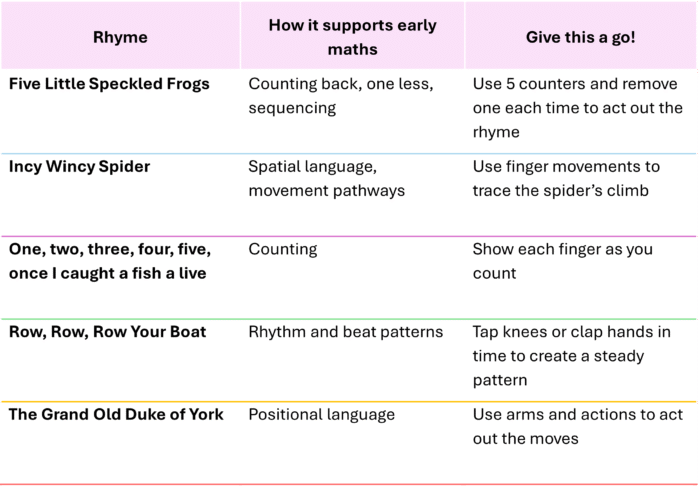
Some of Rethink Maths favourite rhymes

Why Rethink Maths loves nursery rhymes

At the heart of Rethink Foundations is the belief that early mathematical thinking grows through:

  • Gesturing
  • Language
  • Visualisation

Nursery rhymes connect all three.

They don’t require special equipment, they travel with you anywhere, and they build confident learners by making maths feel natural, joyful, and shared.

Nursery rhymes are maths in the real world: counting with fingers, moving in rhythm, noticing patterns in sound and action.

They help lay emotional and cognitive building blocks that later support confident problem-solvers.

A final thought

Whether you are a parent singing during morning routines or a practitioner modelling rhyme in story time, you are building early maths. One gentle rhythm, one shared giggle, one rhyme at a time.

So this World Nursery Rhyme Week, celebrate the small moments.

They’re doing big things.

Check out our free resources to support you bring WNRW to life!

Have we over-simplified the ‘C’ in CPA?

Today I was so inspired by a conversation with Kate Henshall that I had the urge to share it! It reminded me to take a step back and think carefully and deeply about using ‘concrete’ materials and the way children learn.

When we talk about the Concrete–Pictorial–Abstract (CPA) approach in mathematics, many of us instinctively jump straight to the humble counter or cube as our starting point for “concrete.” But have we, perhaps, skipped over some crucial stages in a child’s development of number sense?

Take the number 3 as an example.

At the most fundamental level, learners experience “three” in their world:

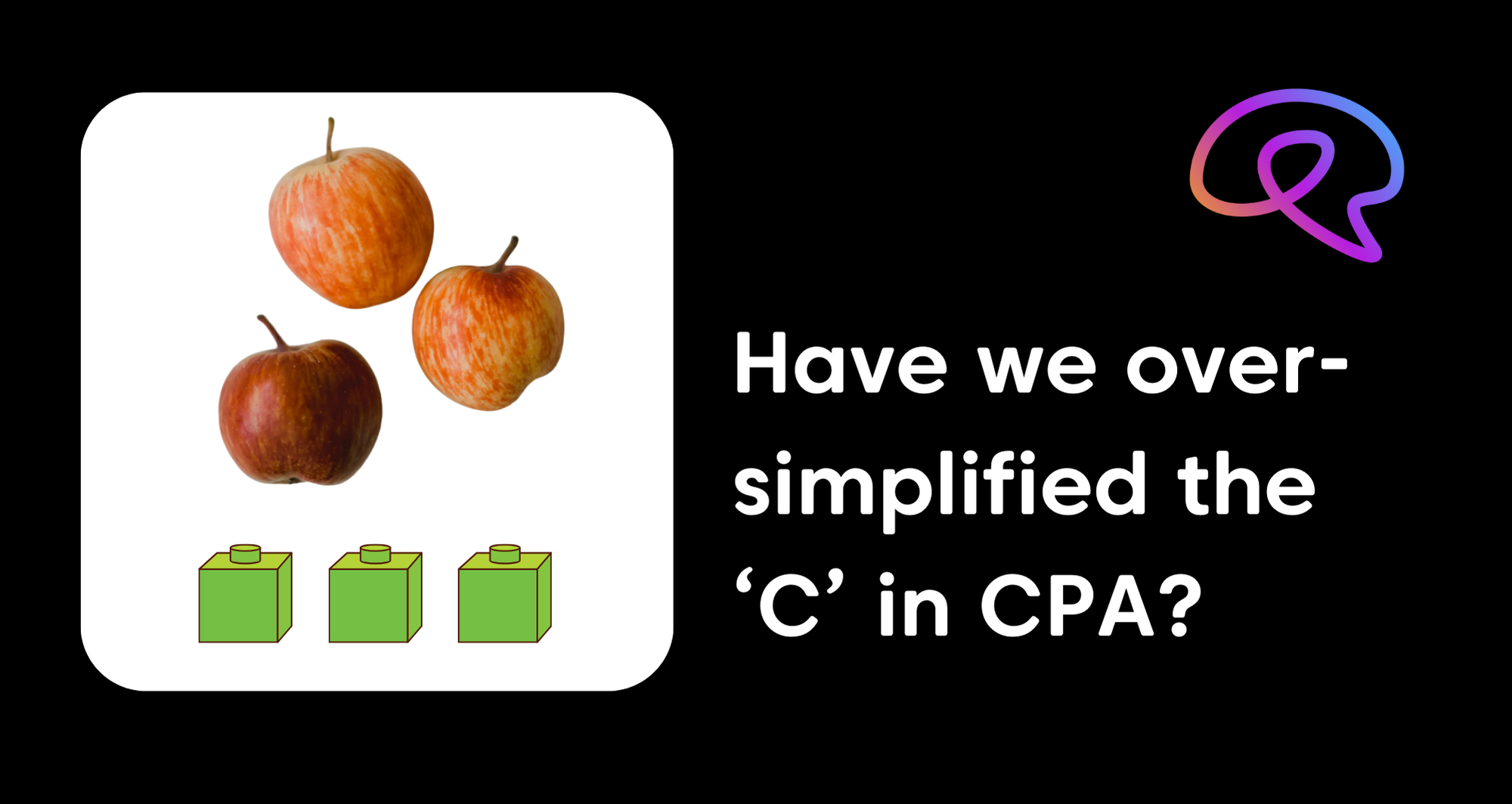
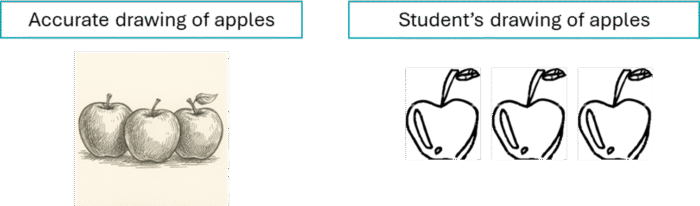
  • Three apples on the table. These are real and familiar.

  • From here, we might move to a photograph of three apples, or even three toy apples. Both are still concrete in feel and appearance but already one step removed.

  • A further step could be a drawing of three apples, a simplified representation that still connects strongly to experience.

Only after these stages might we present:

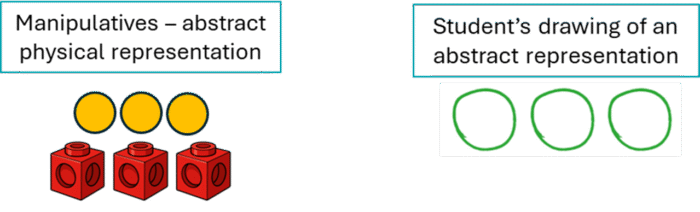
  • Three counters or three drawn circles to stand in for apples.

And here lies a significant leap. The child must now accept that these unfamiliar objects (especially if they differ in shape or colour) represent the apples they know. If the apples were red but the counters are yellow, that’s yet another layer of abstraction for the learner to process.

Each of these subtle shifts marks an important point of cognitive development. If we skip too quickly to counters, we may miss opportunities to strengthen understanding and recognition of “three-ness” in contexts children already trust and understand.

So perhaps we should broaden our view of what counts as concrete. The journey from the real to the representational is a gradual shift through different layers of experience, not one big leap. We must also remember that this journey will not look the same for every child. Some will move through it more easily than others.

Maybe the question we should be asking is not just “Are we using concrete?” but “Have we chosen the right concrete, at the right stage, for this learner?”

We’ve joined BESA!

We’re really excited to share that Rethink Maths has joined BESA (the British Educational Suppliers Association) as Launchpad members.

This feels a bit like coming home for us. We know the BESA team well and have huge respect for the work they do to support schools and the wider education sector. It’s a privilege to be working with them again, especially under the brilliant leadership of Caroline Wright and Julia Garvey.

For us, joining BESA is about reconnecting with people we trust, admire and enjoy working with. We’re looking forward to learning from the network, contributing to the conversation and sharing our journey as we continue to rethink what maths education can be.

We hope to see many of you at the Winter Business Insight Day.

👉 If you’re a fellow BESA member, do say hello — we’d love to connect!

Mary-Kate Connolly joins Rethink Maths as Managing Director

We’re absolutely thrilled to announce that Mary-Kate Connolly is joining Rethink Maths as our new Managing Director!

Mary-Kate brings a wealth of experience in education, leadership, and curriculum development and more importantly, she brings the kind of deep-rooted passion for mathematics that aligns perfectly with everything we stand for.

Mary-Kate is a true believer that maths is for everyone.  She has spent her career to date championing inclusive, impactful teaching and helping teachers support children in making sense of maths, building confidence, understanding, and enjoyment every step of the way.

In her role as Managing Director, Mary-Kate will be overseeing the day-to-day running of Rethink Maths and playing a key role in driving forward our work across the five missions we care deeply about – from building solid foundations and growing confidence, to making maths more inclusive, real-world focused, and joyful to teach.

“We couldn’t be more excited to have Mary-Kate take on this role. Her energy, empathy, and sharp strategic thinking will help bring to life everything Rethink Maths is setting out to achieve.”

Tony Staneff, Co-Founder, Rethink Maths

“Mary-Kate is highly intelligent and has the rare ability to quickly grasp and master new challenges. In an innovative start-up like Rethink Maths, this adaptability is invaluable. We’re lucky to have her as part of the founding team.”

Caroline Hamilton, Co-Founder, Rethink Maths

We can’t wait for what comes next.

Welcome, Mary-Kate, it’s a joy to have you on board.

The power of teaching problem-solving strategies explicitly

Mathematics is more than just numbers, formulas, and procedures – it’s a way of thinking. At its core, maths is about problem-solving: breaking down complex situations, identifying patterns, and applying logical reasoning to find solutions. It is great to see problem solving as a core focus of our national curriculum and long may that continue.

That’s why explicitly teaching problem-solving strategies is so important. It equips students with the skills and confidence to tackle unfamiliar problems, nurturing a mindset that extends beyond the classroom.

Celebrating the work of teachers

First, I’d like to take a moment to appreciate the incredible work that teachers do every day. Teaching problem-solving isn’t easy. It requires patience, a deeper subject knowledge, and the ability to guide students through uncertainty while maintaining engagement. Teachers are already using rich tasks, real-world contexts, and open-ended questions to develop mathematical thinkers. Their dedication lays the foundation for students to build resilience and curiosity in the face of mathematical challenges.  However, during teacher training, we don’t train teachers to teach problem-solving explicitly so it is no surprise that many rely on teaching in the way they were taught.

The case for explicit strategies

We often encourage students to “think logically” or “just try a different approach” when they get stuck. But what if they don’t know how? If we want students to become true problem-solvers, we need to give them specific strategies and model their use. Some key strategies we could be encouraging could include:

  • Working backwards – Starting from the solution or end state and retracing their steps to understand the structure of a problem.
  • Drawing a diagram – Visualising relationships and using powerful techniques such as bar modelling.
  • Looking for patterns – Identifying sequences or repeated structures to make predictions.
  • Making a simpler case – Often this method helps students see the structure of the problem in a more manageable, smaller number set before tackling the actual numbers.
  • Using logical reasoning – Eliminating impossible cases and testing different possibilities systematically.

By explicitly teaching these strategies, we empower students to approach problems with confidence and flexibility.

To try and exemplify some of the methods I talk about here I wanted to take a question from last year’s KS2 SATs problems.  It was towards the end of the first reasoning paper.

Article content

Working backwards method

Encourage them to start from the end (in this case 8 pm) and retrace steps to find what happened in the earlier.

  1. At 8 pm, there are 40 empty seats.

Since the hall has 1,250 seats in total.

Seats that are filled at 8 pm must be 1250 – 40 = 1210

2. At 7 pm, we know 880 seats were filled.

3. So, the number of seats filled between 7 pm and 8 pm must be the difference between these numbers.

1210 – 880 = 330

Drawing a diagram method

A different strategy is for children to create a simple visual (like a bar or boxes) to show changes from 7 pm to 8 pm.

  1. Draw a bar to represent all 1,250 seats.
  2. Mark the portion that is already filled at 7 pm (880 seats).
  3. Show that by 8 pm, only 40 seats are empty.
  4. The difference between these two “filled” sections (1,250 – 880 – 40 = 330) represents the newly occupied seats.
Article content

Making a simpler case method.

  1. Create a smaller-scale version of the same scenario. Suppose the hall had 100 seats instead of 1,250. At 7 pm, 70 seats are filled. By 8 pm, there are 5 empty seats.
  2. Work through the simple version. If there are 5 empty seats, then 95 seats are filled at 8 pm. The number of seats filled between 7 pm and 8 pm is 95 − 70 = 25
  3. Spot the pattern or logic in the simpler version. The difference between the number of seats filled at 7 pm and at 8 pm gives how many were filled during that hour.
  4. Try to scale back up to the actual problem: Use the same approach for the real hall with 1,250 seats. There are 40 empty seats at 8 pm, so 1,250 – 40 = 1,210, replacing the smaller, easier to handle, numbers with the larger ones. Compare with the 880 seats filled at 7 pm to find 1,210 − 880 = 330

A call to evolve our approach

Mathematical problem-solving isn’t just for high attaining students or future mathematicians, it’s a critical life skill. In an ever-changing world, where problem-solving is at the heart of innovation and decision-making, we owe it to our students to equip them with these tools.

Teachers are already doing incredible work, but as a profession, we should continue pushing the boundaries. Let’s move beyond simply teaching students how to solve specific types of problems and focus on developing them as problem-solvers—capable, adaptable, and resilient in the face of the unknown.

So, what needs to change to bring this to life in classrooms?

1.      CPD for teachers about explicit problem-solving strategies.

2.      Teacher guidance within textbooks and resources that highlight the most appropriate strategies for each problem.

3.      Resources that are specifically designed to allow students to practice and experiment with the strategies they have been taught.

What are your go-to problem-solving strategies in the classroom? How do you help students develop their mathematical thinking? I’d love to hear your thoughts.

Why “Rethink” matters to me

When we chose the word Rethink, it wasn’t just a brand decision, it was a mindset.

It’s a word that’s been quietly sitting at the centre of my thinking for a long time. As a leader. As a teacher. As a woman in education. And now, as someone building something new from the ground up.

I believe that sometimes, the most powerful thing you can do is pause… and ask:

  • Does it have to be this way?
  • What if we approached it differently?
  • Who’s missing from this conversation?

I believe in it even more when you are asking those questions about something you have already worked on or built. It’s so easy to become emotionally attached to ideas or ways of doing things but in a fast paced, changing world we need to be flexible.

Rethinking doesn’t mean starting from scratch. Rethinking isn’t about fixing broken things. It’s about evolving what already works.

It means stepping back. Zooming out. Challenging assumptions. And listening to the voices that don’t usually get heard.

I’ve seen what happens when people are brave enough to rethink:

  • Curriculum that truly works for all learners
  • Workplaces that finally value introverted leadership
  • Maths classrooms where girls feel seen, capable and empowered
  • Businesses that follow purpose, not just the bottom line

Rethinking is essential to improving what already exists. Progress doesn’t happen by accident and in life, the job is never really done. When something is “working well enough” it’s easier to tweak than to reimagine. But I’ve found again and again that the most meaningful change starts with the quiet courage to ask: “Is this really serving the people it’s meant to in the best way it could?”

It’s the question I regularly come back to. I believe in the power of rethinking and reimagining, together.

What’s something you’ve rethought lately?

#Rethink #Education #Leadership #ChangeMakers #QuietLeadership