
This weekend at BCME10, we had the pleasure of exploring exactly that with artist and creator of Multicolour Maths, Brook Tate.
On 23 and 24 October, mathematics educators, researchers and practitioners came together in Nottingham for the 10th British Congress of Mathematics Education (BCME10). With a theme of Research and Practice in Partnership, the event provided a wonderful opportunity to share ideas, challenge thinking and explore new approaches to teaching and learning mathematics.
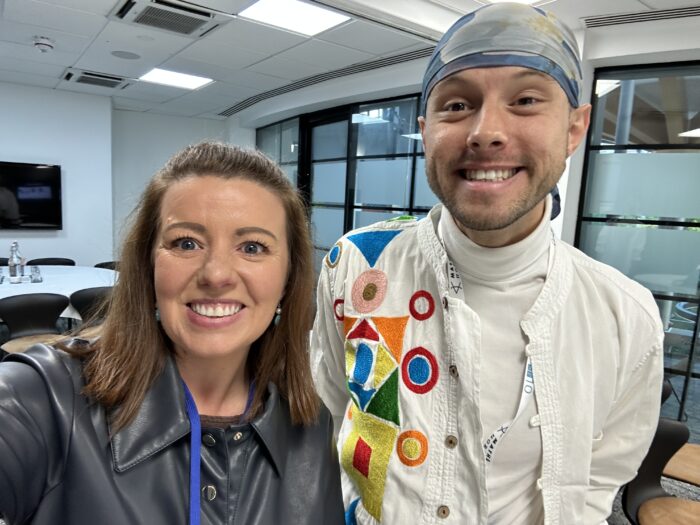
For Rethink Maths, one of the highlights was supporting Brook Tate as he shared his fascinating approach to mathematics in a workshop entitled Multicolour Maths: How art and creativity can impact students’ relationship to mathematics.
From maths anxiety to mathematical discovery
Brook’s journey into mathematics is far from conventional. An artist, musician and performer, Brook spent much of his life feeling anxious about mathematics. Numbers and symbols were something he struggled with rather than enjoyed.
But through his love of painting, colour and pattern, he began to discover mathematics in a completely different way.
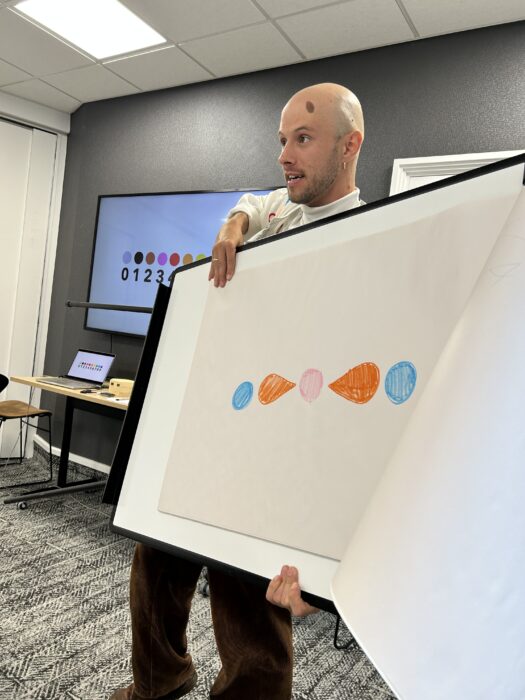
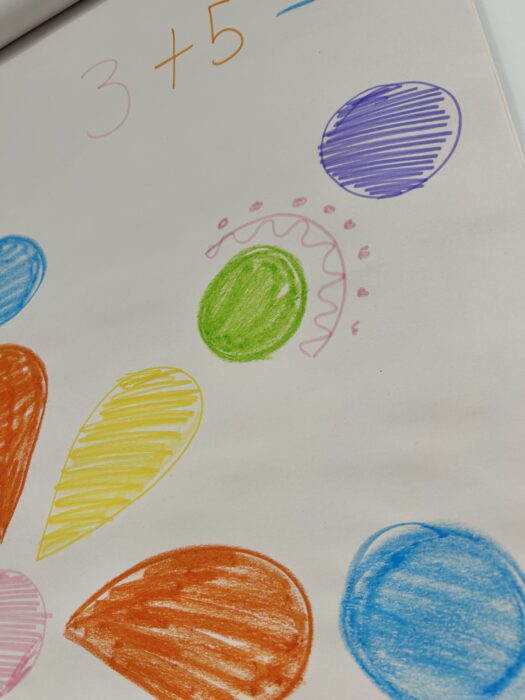
What started as an artistic exploration developed into Multicolour Maths, a visual approach that uses ten colours and simple shapes to represent numbers and mathematical operations. Rather than seeing mathematics as a series of calculations to complete, Brook began to see an interconnected world of patterns, structures and relationships.
It is these relationships that sit at the heart of his work.
Making mathematical relationships visible
One of the most powerful aspects of Multicolour Maths is the way it allows mathematical relationships to emerge visually.
By representing numbers through colour and using shapes to express operations, learners can begin to explore how numbers connect, how patterns grow and how different mathematical ideas relate to one another. The mathematics remains, but the way we experience and interact with it changes.
There is something particularly exciting about moving beyond simply finding an answer to exploring why mathematical relationships exist and what else we might notice.
This is something Brook is incredibly passionate about. His enthusiasm for the patterns and connections that Multicolour Maths reveals is infectious, and it was wonderful to see him sharing this with fellow educators at BCME10.
Mathematics is creative
Perhaps the most important message from Brook’s work is that mathematics is not simply about following rules and getting answers right. It is also about creativity, exploration, imagination and discovery.
Through Multicolour Maths, a calculation can become a pattern, a pattern can become a piece of artwork, and that artwork can reveal further mathematical relationships. Learners are encouraged to experiment, notice, question and create.
For some, particularly those who have developed a negative relationship with mathematics, this offers a different way to engage with the subject.
It also challenges an assumption that we encounter far too often: that people are either creative or mathematical. Mathematics is inherently creative. It is full of beauty, structure and opportunities for original thinking. Brook’s work offers a wonderful reminder of this.
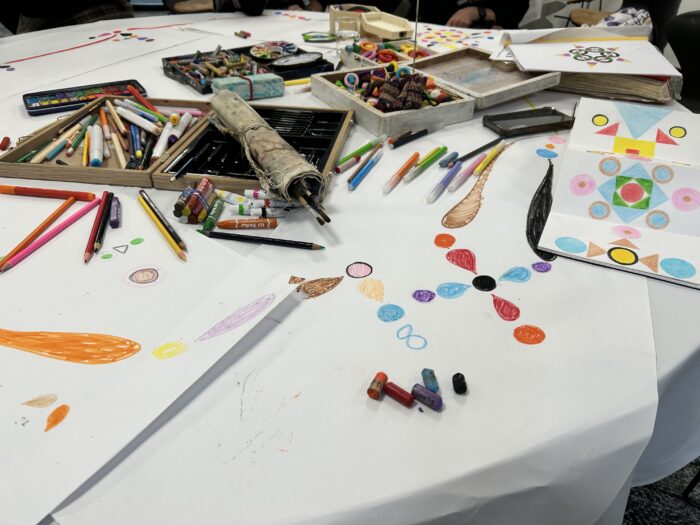
At BCME10, this wasn’t simply something we talked about. Participants were invited to pick up coloured pencils and pastels, experiment with shapes and create their own mathematical artwork. It was a lovely example of how mathematical exploration can be playful, collaborative and creative, while still being rooted in important mathematical ideas.
Rethinking how we experience mathematics
At Rethink Maths, our vision is to change the way the world sees and learns maths.
We believe that developing mathematical understanding should go hand in hand with building confidence, curiosity and enjoyment. We also believe that learners benefit from opportunities to experience mathematics through different representations and perspectives. This is why we are so excited by Brook’s work.
Multicolour Maths offers an intriguing way of looking at familiar mathematical ideas through a different lens. It invites us to think about the connections between visual representations, mathematical understanding and the emotional experiences people associate with learning maths.
There is much still to explore about how this approach might be developed and used in classrooms, but that is part of what makes it so exciting.
We have really enjoyed getting to know Brook and supporting his work, and we look forward to exploring how we might work together to bring his ideas to more teachers and learners.
A colourful future
BCME10 was a fantastic opportunity to connect with others who share a passion for improving mathematics education.
Brook’s workshop was a reminder of the value of bringing together people with different backgrounds, experiences and ways of thinking. Sometimes the most interesting ideas come from looking at something familiar through a completely different lens.
A huge thank you to Brook for sharing his creativity, enthusiasm and love of mathematical relationships.
Want to discover Multicolour Maths for yourself?
Visit www.multicolourmaths.com to find out more about Brook’s work, explore the resources and discover what happens when maths meets art.

