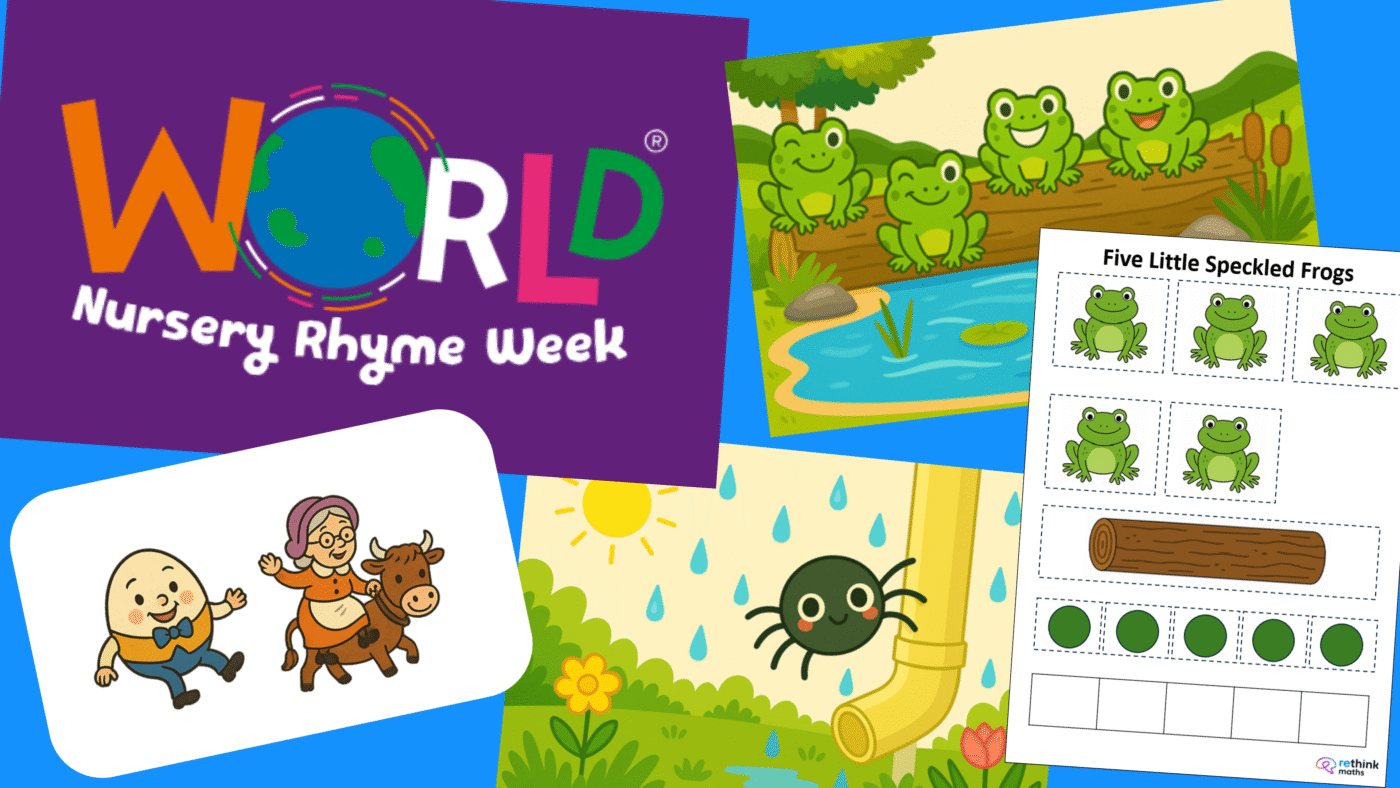
At Rethink Maths we can’t wait to celebrate World Nursery Rhyme Week (WNRW) taking place on 10th to 14th November 2025. WNRW is a wonderful celebration of the songs and rhymes that so many of us grew up with.
But nursery rhymes aren’t just fun little tunes, they’re powerful early learning tools.
One of our missions is ‘Rethink Foundations’, we believe in building deep understanding, lasting confidence and joyful learning through interaction, shared experiences, and play. And nursery rhymes are one way this can be done.
Why nursery rhymes matter
Nursery rhymes:
✅ help children hear patterns in language
✅ support memory and sequencing
✅ encourage early speaking and confidence
✅ offer rhythm and repetition – great for emerging number sense
When a child chants, “One, two, buckle my shoe” or joins in with the actions to, “Round and round the garden,” they’re not just enjoying a moment with you, they’re starting to embed core mathematical ideas:
- Order and sequence
- Counting and comparison
- Spatial awareness
- Patterns and repetition
These foundations support children long before they encounter formal maths.
Singing together
What matters most is how nursery rhymes are shared. Singing together creates a vital sense of belonging and connection.
When a rhyme is shared it can:
- help build language and communication skills
- provide warmth and reassurance
- enable the child to see facial expressions and feel the rhythm of speech
- support emotional security and engagement.
- help the child tune into language and number patterns more deeply
A rhyme becomes learning when it becomes a moment together.
Top tips for bringing maths out of nursery rhymes
- Sing slowly and emphasise the rhythmic pattern.
This helps children notice the beat and the order.
- Add actions.
Actions support memory and coordination. For example, “Wind the Bobbin Up” involves movement, direction, and sequencing.
- Pause to let the child join in.
Leaving small gaps encourages participation and turns it into shared communication.
- Play with objects or props.
For “Five Little Ducks,” use toys or fingers to help children see the number changing.
- Repeat, repeat, repeat.
Repetition strengthens memory and confidence. Children learn through doing things again and again.
Some of Rethink Maths favourite rhymes
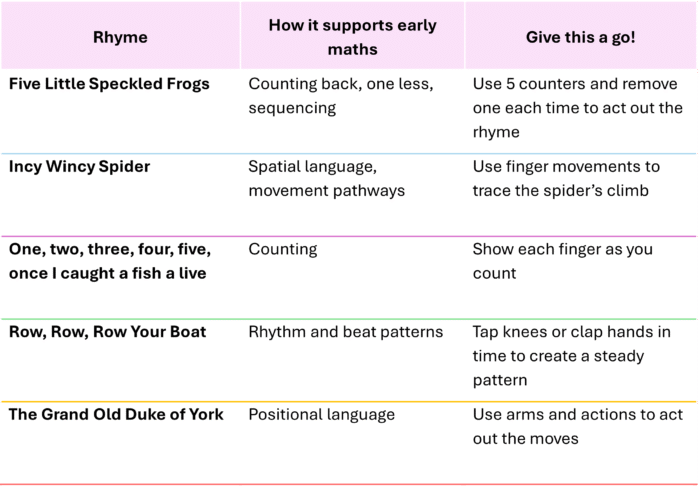
Why Rethink Maths loves nursery rhymes
At the heart of Rethink Foundations is the belief that early mathematical thinking grows through:
- Gesturing
- Language
- Visualisation
Nursery rhymes connect all three.
They don’t require special equipment, they travel with you anywhere, and they build confident learners by making maths feel natural, joyful, and shared.
Nursery rhymes are maths in the real world: counting with fingers, moving in rhythm, noticing patterns in sound and action.
They help lay emotional and cognitive building blocks that later support confident problem-solvers.
A final thought
Whether you are a parent singing during morning routines or a practitioner modelling rhyme in story time, you are building early maths. One gentle rhythm, one shared giggle, one rhyme at a time.
So this World Nursery Rhyme Week, celebrate the small moments.
They’re doing big things.
Check out our free resources to support you bring WNRW to life!