There’s been a lot of noise in the news lately about a new national target – 90 per cent of children reading fluently by the end of Year 2. It’s an ambitious goal, and rightly so. Every teacher I know wants children to leave Key Stage 1 with the joy and confidence that comes from being able to read.
But it got me thinking… why stop there?
If we can have a national ambition for reading, why not for maths too? So here’s my pitch:
By 2030, every child in England should be able to bridge 10 confidently, fluently and flexibly by the end of Year 2.
Bridging 10 might sound like a small skill, but it’s one of those beautiful mathematical turning points that changes everything.
Children who can bridge 10 don’t need to count on fingers for 8 + 7 or 13 – 6 in my experience they understand how numbers fit together.
I remember talking to colleagues during the England–Shanghai Teacher Exchange, and they described bridging 10 as a landmark concept in their teaching – a real foundation for later success. It totally makes sense. Over the years I’ve taught plenty of GCSE students who still rely on their fingers for number work. I never told them off for it, we all do what we need to get by, but it always struck me how much earlier we could have built that understanding.
Think of the collective hours spent by teachers across the country trying to strengthen number sense further up the school. Wouldn’t it make more sense to invest that time earlier?
For me, bridging 10 is one of those invisible thresholds that once children cross it, other things start making sense and feeling easier. Think of where this is used.
Australia Leading the Way
Across the world, education systems are realising the power of these early building blocks. Over the weekend I spotted an article about education reform in Australia. Their new national plan starts right where it matters most – maths in the Foundation to Year 2 years. They’re simplifying what’s taught, clarifying the order, and helping teachers focus on the bits that really matter. It’s exactly the right place to start.
And there is an opportunity to do the same here
With the final outcome of the Curriculum and Assessment Review looming, this is the perfect moment to be bold and to put early number back at the heart of our national conversation. Not to beat schools with a stick or churn out another spreadsheet of league tables, but to set a shared goal, a north star for what success in early maths looks like. A collective ambition that says – this is what we value; this is what we’re all working towards.
Of course, it’s important to say this isn’t about reducing mathematics to one narrow goal. Bridging 10 matters deeply, but it’s just one part of what it means to think mathematically. Alongside it, children need to explore shape, pattern, structure, measurement and geometric reasoning – all the strands that make maths rich, creative and connected. A national focus on early number shouldn’t mean everything else fades away – it should act as a foundation that strengthens the whole mathematical journey.
So yes, let’s keep our 90 per cent reading target but consider another one too.
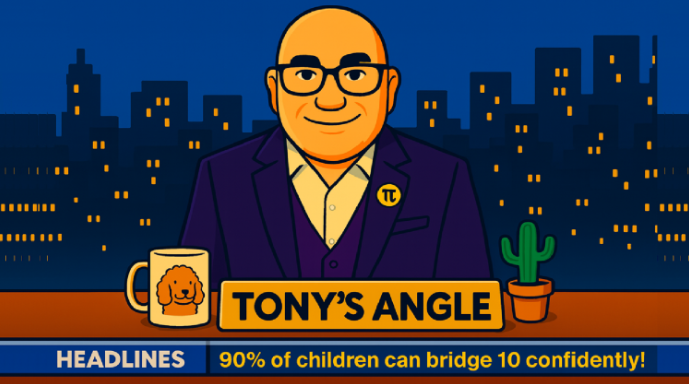
By 2030, 90 per cent of children in England can bridge 10 with confidence, fluency and joy.
A small skill with a massive ripple effect.
Something like this feels like a national mission worth getting behind.
And that’s what Tony reckons.