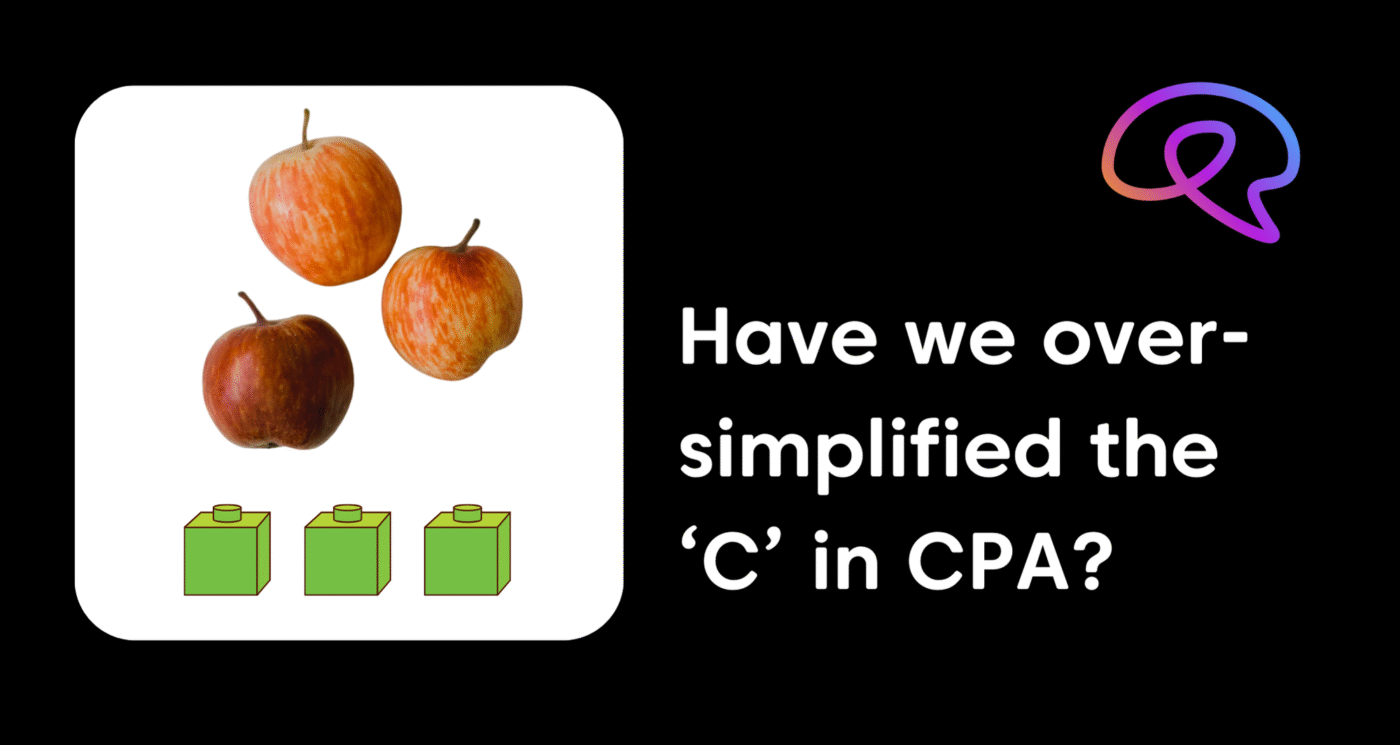
Today I was so inspired by a conversation with Kate Henshall that I had the urge to share it! It reminded me to take a step back and think carefully and deeply about using ‘concrete’ materials and the way children learn.
When we talk about the Concrete–Pictorial–Abstract (CPA) approach in mathematics, many of us instinctively jump straight to the humble counter or cube as our starting point for “concrete.” But have we, perhaps, skipped over some crucial stages in a child’s development of number sense?
Take the number 3 as an example.
At the most fundamental level, learners experience “three” in their world:
- Three apples on the table. These are real and familiar.

- From here, we might move to a photograph of three apples, or even three toy apples. Both are still concrete in feel and appearance but already one step removed.

- A further step could be a drawing of three apples, a simplified representation that still connects strongly to experience.
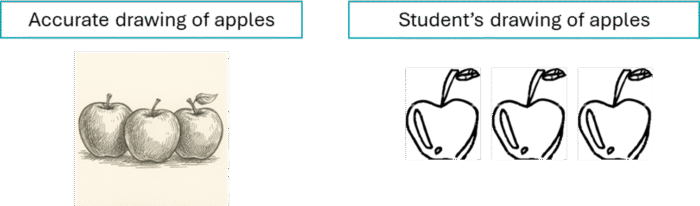
Only after these stages might we present:
- Three counters or three drawn circles to stand in for apples.
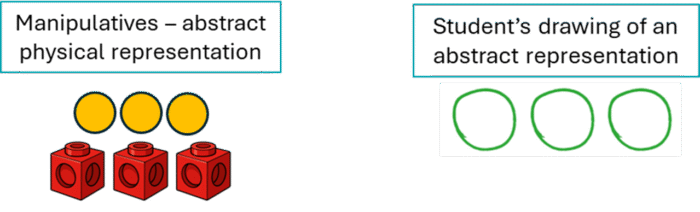
And here lies a significant leap. The child must now accept that these unfamiliar objects (especially if they differ in shape or colour) represent the apples they know. If the apples were red but the counters are yellow, that’s yet another layer of abstraction for the learner to process.
Each of these subtle shifts marks an important point of cognitive development. If we skip too quickly to counters, we may miss opportunities to strengthen understanding and recognition of “three-ness” in contexts children already trust and understand.
So perhaps we should broaden our view of what counts as concrete. The journey from the real to the representational is a gradual shift through different layers of experience, not one big leap. We must also remember that this journey will not look the same for every child. Some will move through it more easily than others.
Maybe the question we should be asking is not just “Are we using concrete?” but “Have we chosen the right concrete, at the right stage, for this learner?”